

Outsource Data Entry Services in 2026: What Is Changing and What It Means for Your Business
If outsource data entry services is what you have been considering for this year, the situation has changed in comparison with what it was just two years back. Software is capable of automatically deciphering the content of an invoice or form. Privacy legislation has been introduced in India to protect personal data. Questions regarding the quality and security of the process are more relevant now than concerns about the cost of outsourcing in the past. This article describes the major trends in clear language.
Why the Question Has Changed
For decades, there was just one question: “Will it be less expensive to take my typing offshore?” It is still important, but it is not the key one anymore.
Instead, most companies are trying to answer another one, like: “What of my tasks shall a machine do, what a human being, and who can deliver such a mix?” Offshoring is shifting away from “hire typing” to “hire a team that works a certain process.” Recognizing it allows us to frame relevant questions and to save money on unnecessary services.
Trend 1: Software Does the First Pass, People Check the Rest
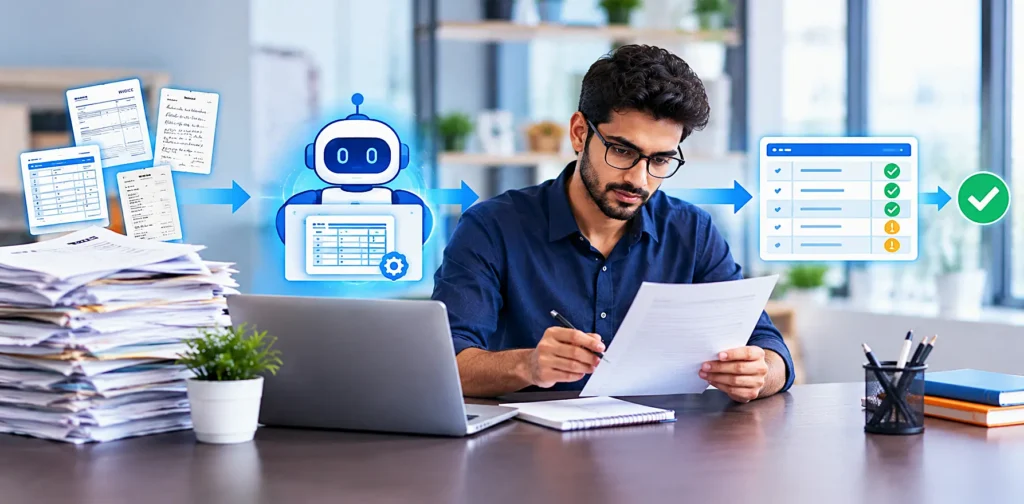
The biggest change is the collaboration between AI technologies and humans. The software can scan many clear invoices, forms, and spreadsheets and extract the fields. It has trouble working with unclear scans, handwriting, unusual layouts, and entries that are not consistent with the standard format.
According to market research firms like Technavio, the “human-in-the-loop” approach is the industry standard at this point. The automation is responsible for the first pass, and the people are checking the unclear entries. There are several articles in the industry from 2026 that mention the same trend. Companies are not developing fully automated data pipelines.
This means that:
- Inquire of any vendor about their automation process and human involvement. If the answer is clear, it is a positive sign. An ambiguous answer or a statement about full automation by software is a red flag.
- Avoid assuming that manual typing is the only way to go. The vendor that utilizes automation for the mundane tasks and human labor for the review process will most likely be more efficient and make fewer mistakes.
- Beware of near-perfect accuracy claims. It is determined by the document type, source quality, and process of verification. Inquire how the vendor measures accuracy.
Trend 2: Privacy Rules Now Shape Who You Can Choose

India enacted the Digital Personal Data Protection Act in 2023. The government issued the regulations on 13 November 2025. The regulations take effect gradually. Law firm descriptions set the date for when compliance obligations begin at 13 May 2027, 18 months after the issuance of the regulations. The Act authorizes heavy fines for breaches, going up to ₹250 crore according to a Grant Thornton description of the Act.
The crucial thing for outsourcing is that liability remains with the organization that owns the data, even if another organization processes the data. Indian organizations processing personal data are thus being urged to establish clearly stated controls. Client organizations are applying pressure in the opposite direction. Vendor commentary dating back to mid-2026 suggests that clients in the US and Europe now require privacy policies and data processing agreements to be signed before outsourcing contracts can be signed.
However, one thing must be mentioned here. Legal authorities claim that in some cases, the Act would not apply to foreign clients’ information processed in India according to the contract. There could be differences depending on industries and types of data. If you deal with sensitive personal information, consult a lawyer specializing in your industry. You should not base yourself on some general advice only. For example, on this one.
What you can do:
- Request a confidentiality agreement in writing before sending any files.
- Find out who in the service provider company has access to your information and what steps they take to restrict this access upon termination of the engagement.
- Learn about ways of transferring and storing data. A plain email attachment would not be the proper way to do that.
- Find out what actions would be taken in case of any breach, and how quickly.
- Also, check their security certificates.
Trend 3: India’s Outsourcing Market Is Moving Up

India has been the main provider of offshore data processing for quite some time now, and the market continues to grow. According to the forecasts from the Kotak Institutional Equities report, cited in the trade press, Indian BPO exports will amount to approximately $45 billion in 2026, or around 20% of global outsourcing expenditure. According to the same press coverage, BPO exports have been growing faster than IT services exports.
Another indicator of change is the rise of global capability centers. They are in-house operations of large international firms operating in India. Numbers vary across sources, ranging from 1,500 to 1,900, yet all of them describe the rapid growth. Reports on these centers indicate that they perform high-value tasks including analytics, finance operations, engineering, etc., in addition to standard back-office tasks.
What does this imply for a small firm that wants to outsource data entry services?
- The competition for skilled personnel is fiercer, which can lead to increased pricing for specialized tasks like medical or financial data processing.
- Routine, rule-based tasks are still abundant and affordable.
- Providers are differentiating themselves through processes, security, and reporting rather than just low prices. This is great for demanding clients.
Trend 4: Buyers Want Clear Service Terms, Not Just a Rate Per Hour

Previously, most outsourcing agreements were priced based on the number of people or by the hour. Now, in 2026, it looks like things will start going toward more clearly defined “done” conditions in the terms of service. As an industry article on Outsourcing vs. In-House says very well, “outsource success comes from treating it as a managed production process, not labor for hire”.
Terms should include:
- Target accuracy: how is it evaluated, in how many items, and by whom?
- Normal turnaround time: usual time plus what happens in rush period.
- Correcting errors: who, how quickly, and what will it cost.
- Track changes: whether it is possible to see what has been edited and why.
- Reporting: how often, in what form, and with what information.
If some of these topics are overlooked, problems usually happen: “Done” has one meaning for you and another for a service provider, and no one is right.
Trend 5: The Work Is Moving From Typing to Checking and Cleaning

- reviewing the results of automated programs
- correcting non-matching entries
- deleting duplicate data entries
- formatting data entries across platforms
- working with documents that are difficult for automated programs to interpret.
This is important for you to consider when deciding what to outsource. A heap of unorganized files that don’t have any set format is a tougher task and much more valuable one than just typing organized data.
What to Outsource and What to Keep In-House

But not all data projects are suitable for outsourcing. There is a simple litmus test for that:
Suitable for outsourcing
- Those that are based on clearly-defined procedures and performed frequently
- Large volumes of standardized data
- Backlogs of scanned documents to be converted into electronic format
- CRM cleanup, product cataloguing, and invoice entry
- Contact lists compiled from publicly available sources with a standard set of fields
Best left in-house
- Those that require subjective decisions and specific context of your company
- Live data entry while talking to a customer
- Data which is highly sensitive, and you don’t want outsiders to have access to it
- Those that are still poorly defined, as a fuzzy procedure produces a fuzzy outcome when followed by another person
If you cannot write a brief description of the task, solve this problem first. The clearest instruction is the best asset you can provide to an external team.
Questions to Ask Before You Outsource

- How do you verify accuracy, and how many people see a record prior to mine?
- Where do you use automation, and where do you need manual intervention?
- What process do you follow in case of post-delivery discovery of a mistake?
- Who is allowed access to my records, and how is access discontinued once the project is completed?
- Can we start with a pilot phase before signing a long-term contract?
- What kind of reporting will be provided, and what are its frequency and format?
- How do you deal with an unexpected spike in traffic?
Focus on the level of detail in the answers received. A confident answer that gives you the details is more helpful than an eloquent answer with none.
Common Mistakes Buyers Make
Selecting based only on price. A cheap fee without the review stage will cost you more when you factor in the amount of time wasted fixing the mistake.
Assigning the toughest tasks first. Begin by giving a simple task. The poor-quality result from a difficult task gives you nothing about the provider and tells you everything about the task.
Forgetting about the written instructions. Verbal instructions fade away quickly. A page or two of written instructions with examples saves you from many early mistakes.
Not asking about the exit strategy. How will you retrieve your data after using their services? If you stop using their service, what happens to your data on their systems?
Thinking that software can replace all the reviewing process. Software may help, but studies from 2026 say otherwise.
A Simple Way to Start
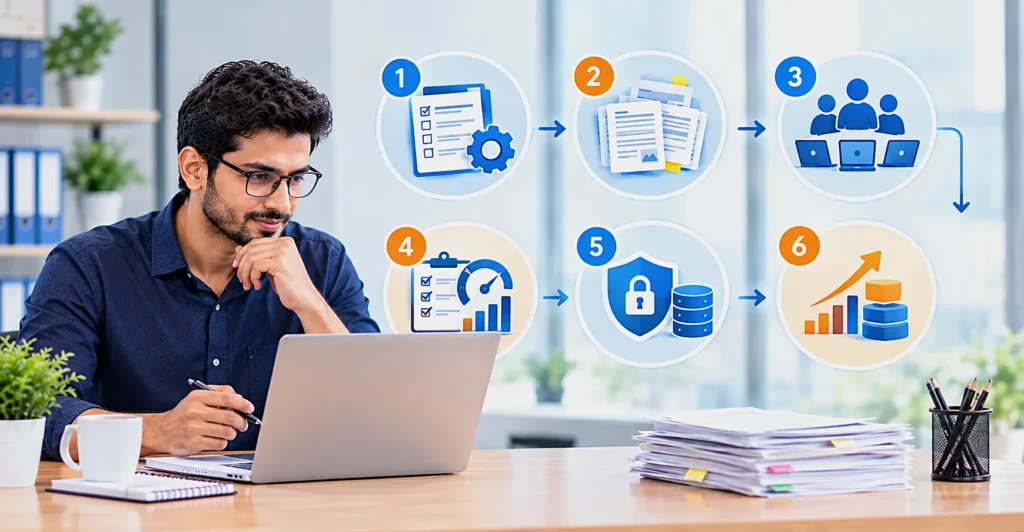
- Choose one repeated activity, and list the rules for that in clear steps.
- Gather 50 to 100 sample records, including some that are difficult.
- Get two or three providers to process the same sample.
- Measure their accuracy, speed, and communication clarity.
- Check their security and privacy response before you share any real information.
- Scale up only when the sample shows results consistently a couple of times.
Final Thoughts
Outsource data entry services in 2026 is not a matter of getting the cheapest typist but of getting a group of people who will execute a rigorous process. Automation has taken care of the easy part. Privacy laws in India are making requirements stringent for vendors. The offshore market is expanding and becoming skill-based. To the buyers, this translates into more informed questioning, terms in writing, and pilot projects before making big commitments.
Companies that do their homework generally have more success than those who rely on price and hope.
Disclaimer: This article is provided for general information only. For specific legal advice regarding data protection in your industry, please consult a qualified lawyer.
Frequently Asked Questions
What does it mean to outsource data entry services?
Data entry outsourcing involves the use of an external company to perform activities such as typing records, database management, document scanning, and spreadsheet cleaning. You control the process and check the work done while the service provider provides the manpower and equipment. It is commonly used by organizations to save time and maintain accuracy as data increases.
Will AI replace outsourced data entry in 2026?
Not entirely. Computers are good at processing neat files, but not very good at dealing with poor-quality scans, handwriting, and strange formatting. Most companies employ a hybrid approach where software makes the first try and humans check the uncertain data entries. The trend moves away from simple typing to data verification and organization.
Is it safe to outsource data entry to India?
However, it is secure provided that the outsourcing service provider has some clearly defined security measures in place. Make sure that you get a signed agreement, limited access to files, secure transfer mechanisms, and proper deletion of your information once the task is done. Data protection laws in India will become effective by 2027.
How much does it cost to outsource data entry services?
The price is determined by the volume of work, the quality of the documents, the level of accuracy required, and the deadline. Clean and systematic work is cheaper than messy work or specialty documents like medical records. Service providers charge per entry, per hour, or per job. Consider the full price of the service, including the price for errors, not just the basic price.
Which data entry tasks are best to outsource?
Tasks that are rule-based and repetitive should be outsourced: Customer relationship management updates, invoice processing, product descriptions, scanning and entering data from documents, order processing, and lead generation from public sources. Keep the task in-house if it requires judgment, context, direct client interaction, or highly confidential information. Tasks that you cannot describe in a clear brief writing should not be outsourced.
How do I choose a reliable data entry provider?
Find concrete answers to questions, rather than vague promises. Ask how many individuals check each document, how mistakes are corrected, who has access to your information, and what kind of reports you will get. A reliable company will give you a small paid or free trial, service terms, and good communication. Compare two or three companies on the same test task.
How long does it take to start and see results?
Most companies can get started on the test right away once all the necessary instructions and sample files are available. In most cases, just a few sample files can be enough for the company to see how well the process can be executed in about one to two weeks. The more complex projects are then included in the process.