
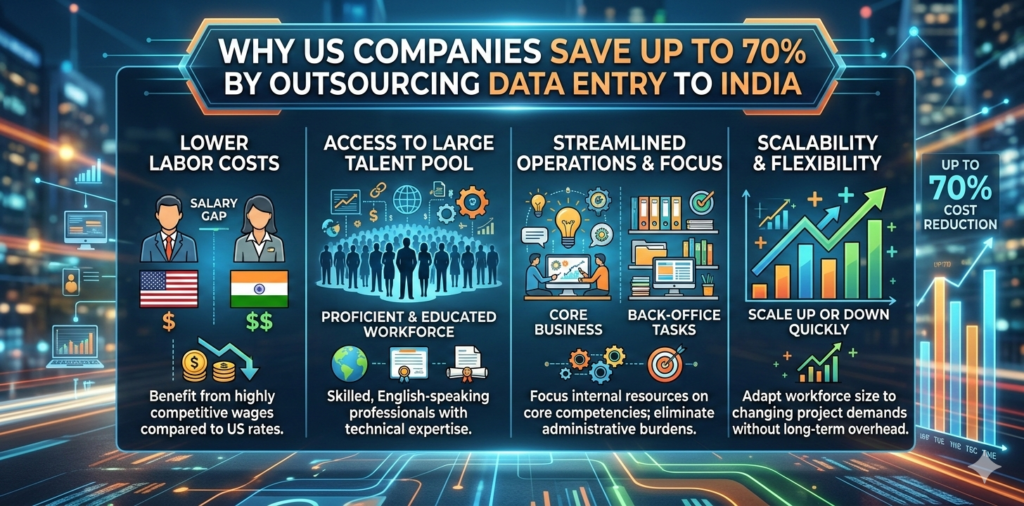
Why US Companies Save Up to 70% by Outsourcing Data Entry to India
In the United States, data entry is crucial for many businesses; however, entering data takes large amounts of money. Daily data entry inputting of invoices, customer records, product catalogs, and forms is required for every business. Developing an internal department to perform repetitive, routine data work requires significant resources and costs; especially any additional time on manager(s) to oversee departmental operations will likely exhaust both your operating budget and the company.
Because of this reality, thousands of companies are turning to India for outsourcing their data input and data entry process. The decision to choose outsourcing India is not financially based solely on Labor Rate (lower). Rather, there are several considerations (Currency Advantage, Cost of Operations, Scalability, and Access to a Higher Skilled Labor Source at Doctorate Level and Cost-Effective) that are playing a role in the final decision.
Let’s make it clear.
How Much Does Data Entry Cost in the USA?
When hiring a US-based data entry operator there are other cost elements to take into account (besides base pay).
Other costs typically paid on monthly basis per employee:
- i. Base Salary: $2,500 - $3,500
- ii. Payroll Taxes and Compliance: $300 - $500
- iii. Health Insurance and Benefit: $400 - $800
- iv. Office Space and Utilities: $300 - $700
- v. Equipment and Software: $150 - $300
- vi. Management & HR Overhead: $200 - $400
Total Estimated Cost per Employee: $3,850 - $6,200 per Month
This is a full-time employee performing repetitive, process driven work with no real direct revenue generation to support the cost of the employee.
The Growth of Your Company and Growth of Your Data Entry Team – Quickly Turn to Financial Ruin
During the growth of a company, if you were to multiply the number of data entry staff and value of each of those employees on a monthly basis will quickly deplete your operating capital resources.
Currency Considerations (Indian Rupee Versus US Dollar) - The Match of US Dollar Value vs Currency Advantage
One major financial advantage of outsourcing data entry to Indian India, On Average, 1 US Dollar Is Worth Approximately 90+ Indian Rupees (The Exchange Rate Fluctuates).
In The US, Companies Pay Their Employees with US Dollars.
In India, The Majority Of Employer Expenses Are Costed In Indian Rupees.
These Currency Exchange Rate Differences Provide Strong Purchasing Power For Employers.
Then For Example, The Costs of Having One Junior Level Employee in The US Can Fully Fund an Entire Managed Team in India, Including All Required Infrastructure, Supervision and Quality Control Checks. Due To The Lower Living Costs and The Reduced Cost of Real Estate, As Well As the Well-Established Outsourcing Ecosystem, Indian Service Providers Can Produce High Quality Work at Globally Competitive Prices.
It’s More About Where the Employment Base Is Located and What the Economic Structure Is Versus Whether or Not You Are Paying a Lower Rate for Your Employee in India.
The Comparison Between Acquiring the Equivalent Of $500/Month USD In India Versus $500/Month in the US Is Substantial.
If You Are Spending $500/Month in The US You Are Most Likely to Get:
- A Part-time Freelance Employee
- Limited Availability
- Lack Of Visibility and Accountability
- No Dedicated Supervision
- No Guarantee of When Work Will Be Completed
- No Formal Data Security Program
If You Are Spending $500/Month in India You Are Most Likely to Get:
- A Skilled Dedicated Employee That Works 40 Hours Per Week
- Managed Services
- Quality Control Processes That Deliver High Quality Work
- Daily Productivity Tracking
- Secure Data Handling Processes and Procedures
- Flexible Hours and Shift Arrangement Options for Working Across Time Zones
- Backup Resources to Ensure Business Continuity
The Difference Between the Two Scenarios Is Large. By Operating At a Scale Greater Than Anyone Would Be Able to Achieve on Their Own Outsourcing Companies in India Are Able to Distribute Their Infrastructure and Management Expense Over a Very Large Number of Clients Creating a Significant Cost Advantage for Their Clients.
Cost Savings Case Study: Prior To & After Outsourcing
Example: E-Commerce business – mid-sized company – located in USA
Before outsourcing (in-house team):
- i. 3 data entry clerks.
- ii. Total monthly cost per employee $4,500/month.
- iii. Monthly Expense= 3 x 4500 = 13500
- iv. Annual Cost:
- v. 13500 x 12 = 162000
After outsourcing to India:
- i. Managed team of equivalent level to 3 employees
- ii. Cost of service package: $3,800 per month
- iii. Monthly Expense= $3,800
- iv. Annual Expense= $45,600
Total savings per year:
$162,000 − $45,600 = $116,400 saved per year
Percentage reduction of costs ~72%.
At the same time, the company will also gain:
- Faster Turnaround Time
- 24/7 Work cycles
- Less management load
- Easier to scale during peak times
- Cost savings are only a part of the whole. Operational Efficiency is also enhanced.
- Quality of Service is High
Why the Quality Remains High
Modern Indian outsourcing firms invest in:
- Highly Skill English Speaking Work Force
- Standard Operating Procedures
- Multiple Levels of Quality Checks
- Secure File Transfer Systems
- ISO Certified Processes (most firms)
- Global client experience.
India has been an international outsourcing destination for well over 20 years. Data entry, back-office functions, and business support services are mature industries with highly effective delivery models.
How to Begin Without Taking on Any Risk
Many U.S. companies do not pursue outsourcing because of a fear of losing control and/or security of data. Providing evidence of their commitment to risk-free transition will alleviate a majority of these fears.
Safe ways to get started:
1) Free Trial Projects
Evaluate performance on accuracy, speed & communication prior to committing.
2) Pilot Projects
Begin with a small workload and scale up.
3) Flexible Monthly Contracts
No long-term lock in period.
4) NDA & Data Security Agreements
Legal protection and guarantee of confidentiality.
5) Dedicated Account Manager
One point of contact to ensure smooth communications and operations.
6) Transparent Pricing
Detailed deliverables and verifiable KPIs.
Outsourcing is best accomplished when viewed as a partnership versus a vendor relationship.
Conclusion
Outsourcing data entry to India is not solely a method to save money; it is a strategic decision that provides the U.S. business with:
- Reduced Operating Expenses
- Improved Process Efficiency
- Access to Skilled Labor
- Ability to Scale-Up Without the Difficulty of Hiring
- Focus on Core Job Functions for Internal Employees to Help Drive Growth.
When routine tasks are completed at a lower cost and remain reliable, the organization finds itself with the ability to innovate and more effectively compete.
That is the true benefit.